See which launches you can spot and which way to face.
Enter your ZIP code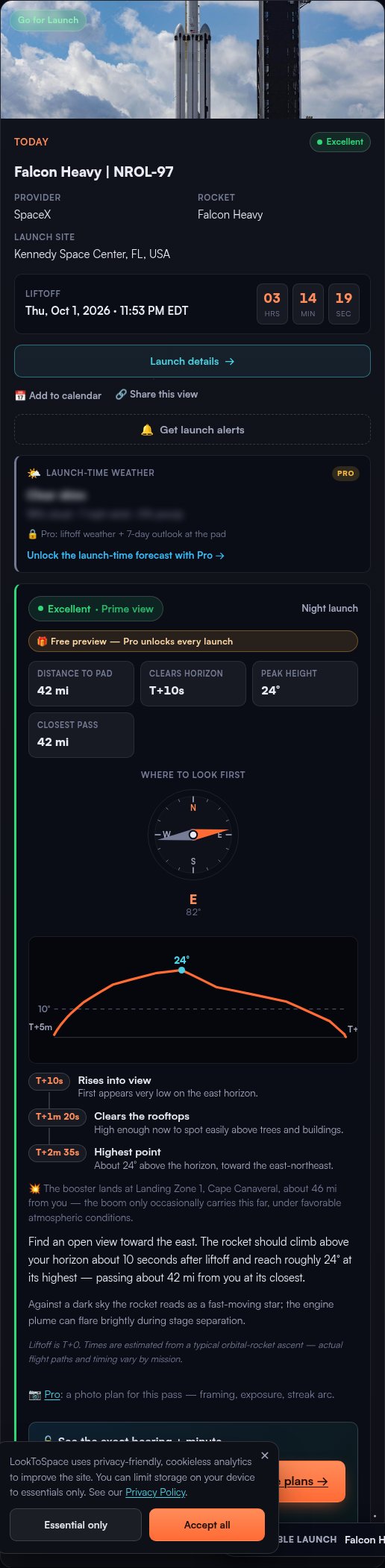
Enter your ZIP code to see which launches you can spot from your yard.
We understand how it feels to stand outside staring at the wrong patch of sky. Nobody should have to guess whether a launch is visible from their own yard.
We model the rocket's climb above your horizon, so you know which way to look, and when.
We do not yet publish a measured match rate against real sightings. They model the rocket’s path above a clear horizon; clouds, terrain and changes to the flight path can change what you see.
Often, yes. A rocket climbs high enough to rise above the horizon for viewers hundreds of miles away. Whether you can see it depends on distance to the pad, the launch trajectory, the time of day, and your weather. Enter your ZIP code or city above and LookToSpace estimates it for every upcoming launch.
Look toward the launch site, then a little along the rocket’s flight path. LookToSpace tells you which way to face from your location (Pro shows the exact compass bearing in degrees). The rocket first appears low on the horizon in that direction and then climbs and tracks across the sky.
A bright daytime launch is usually clear within 100-150 miles. At night the engine plume can be seen 300-500 miles away, and a twilight launch (sunlit exhaust against a dark sky) can be visible 500+ miles from the pad in good conditions.
Night and twilight launches are far easier to spot at a distance. The engine exhaust glows brightly against a dark sky, and twilight launches in particular create a dramatic, fanning plume. Daytime launches are only easy to see relatively close to the pad.
Launches slip constantly: upper-level winds, weather, technical checks, range conflicts, or readiness of the payload. A time marked TBD or TBC is not yet confirmed. Always re-check close to the date.
Yes. Low cloud over the pad or along the early trajectory can hide the rocket entirely, and haze cuts long-distance visibility. Clear skies toward the launch site give the best chance; check the forecast before you head out.
Built for naked-eye launch watching from US locations. Visibility estimates are not launch-control forecasts or a guarantee of a sighting. How estimates work.