New Glenn Blue Ring-1 — launch date, time, visibility & where to look
The first mission of Blue Ring, Blue Origin's all-in-one, high-powered hybrid solar electric and chemical propelled spacecraft, will test the spacecraft's operations in Geostationary Transfer Orbit (GTO), as well as subsequent operations after reaching Geostationary Orbit (GEO). It will carry one of Scout Space's flagship next-generation space domain awareness (SDA) Owl sensors, which is designed to enhance real-time tracking, characterization, and assessment of space objects by integrating advanced optical sensing, onboard artificial intelligence-driven processing, and autonomous decision-making capabilities to deliver domain-wide intelligence in space in support of the U.S. Space Force’s space control mission set. Blue Ring will also carry Optimum Technologies (OpTech)'s next-generation Caracal optical payload, which is designed to provide actionable insights on resident space objects and orbital activity and includes onboard image storage, object detection algorithms, and passive thermal control. The payload is designed to operate flexibly across dynamic orbits over a year-long mission profile. Several internal Blue Origin payloads will also be hosted.
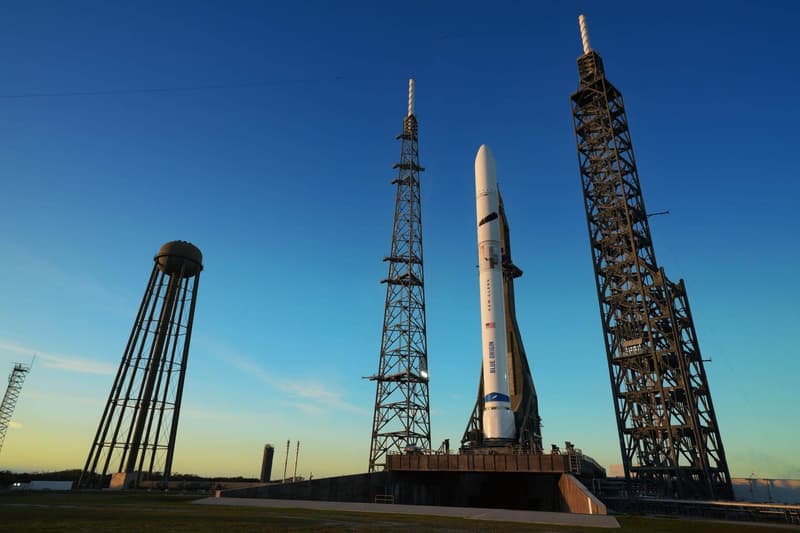
Countdown to liftoff
Targeting December 2026 — the exact date and time are not set yet. Launch dates firm up close to the attempt; set a free alert below to get the final time.
Launch time
- December 2026 — exact date and time not announced yet
This launch time is not yet confirmed. Rocket launches often slip by hours or days for weather, technical checks, or range scheduling; treat the time above as a target and re-check close to the date.
Free email alerts for New Glenn | Blue Ring-1
A heads-up the day before, a reminder an hour out, Go-for-launch confirmation, and an email if the date moves.
Click the one confirmation email we send to activate. One-click unsubscribe.
Free email alert + a note if the date moves ✓ what you’re signing up for now
Pro launch-day texts · the weather at liftoff · a minute-by-minute where-to-look plan for your spot · $19.99/yr
Free · no account needed
Sky outlook at the pad
Daily cloud cover and rain chance at Cape Canaveral SFS, FL, USA (liftoff is still beyond the 7-day forecast window):
- Today
- Sun
- Mon
- Tue
- Wed
- Thu
- Fri
Forecast at the launch site; check your own sky too: cloud over you can hide a launch the pad forecast says is clear.
Pro members get an hour-of-liftoff go/no-go call (cloud, wind, rain chance and visibility) in the launch finder. Pro · $19.99/yr
Visibility map: how far away can you see it?
Each ring shows how far away New Glenn is line-of-sight visible that many seconds into flight: about 89 miles by T+30s, 192 miles by T+60s, and roughly 305 miles by T+90s. City dots are colored by the expected view quality; the table below has the direction to look from each.
Which cities can see this launch?
Estimated visibility from major towns near US launch sites, assuming clear skies and an open horizon. The 10 most likely first:
| City | Visibility | Look toward | Distance to pad |
|---|---|---|---|
| Port Canaveral, FL | Excellent | northeast | 6 mi |
| Cocoa Beach, FL | Excellent | north-northeast | 11 mi |
| Merritt Island, FL | Excellent | northeast | 12 mi |
| Rockledge, FL | Excellent | northeast | 15 mi |
| Titusville, FL | Excellent | east-southeast | 19 mi |
| Satellite Beach, FL | Excellent | north | 20 mi |
| Mims, FL | Excellent | southeast | 22 mi |
| Indialantic, FL | Excellent | north | 26 mi |
| Melbourne, FL | Excellent | north | 27 mi |
| Palm Bay, FL | Excellent | north | 31 mi |
Show all 94 cities
| City | Visibility | Look toward | Distance to pad |
|---|---|---|---|
| Sebastian, FL | Excellent | north | 45 mi |
| New Smyrna Beach, FL | Excellent | south-southeast | 45 mi |
| Sanford, FL | Excellent | east-southeast | 50 mi |
| Orlando, FL | Excellent | east | 51 mi |
| Kissimmee, FL | Excellent | east-northeast | 54 mi |
| Vero Beach, FL | Excellent | north | 58 mi |
| Daytona Beach, FL | Excellent | south-southeast | 59 mi |
| Fort Pierce, FL | Excellent | north | 72 mi |
| Port St. Lucie, FL | Excellent | north | 84 mi |
| Palm Coast, FL | Excellent | south-southeast | 87 mi |
| Lakeland, FL | Good | east-northeast | 91 mi |
| St. Augustine, FL | Good | south-southeast | 109 mi |
| Tampa, FL | Good | east-northeast | 122 mi |
| West Palm Beach, FL | Good | north-northwest | 125 mi |
| Gainesville, FL | Good | southeast | 135 mi |
| Jacksonville, FL | Good | south-southeast | 145 mi |
| Fort Lauderdale, FL | Good | north | 164 mi |
| Miami, FL | Good | north | 189 mi |
| Brunswick, GA | Good | south-southeast | 194 mi |
| Valdosta, GA | Fair | southeast | 232 mi |
| Savannah, GA | Fair | south | 252 mi |
| Hilton Head Island, SC | Fair | south | 259 mi |
| Tallahassee, FL | Fair | east-southeast | 263 mi |
| Charleston, SC | Fair | south | 300 mi |
| Myrtle Beach, SC | Marginal | south-southwest | 374 mi |
| Pensacola Beach, FL | Marginal | east-southeast | 417 mi |
| Gulf Shores, AL | Not visible | — | 448 mi |
| Grand Isle, LA | Not visible | — | 575 mi |
| Norfolk, VA | Not visible | — | 629 mi |
| Virginia Beach, VA | Not visible | — | 637 mi |
| Newport News, VA | Not visible | — | 641 mi |
| Richmond, VA | Not visible | — | 652 mi |
| Cape Charles, VA | Not visible | — | 662 mi |
| Exmore, VA | Not visible | — | 683 mi |
| Onancock, VA | Not visible | — | 696 mi |
| Wallops Island, VA | Not visible | — | 714 mi |
| Chincoteague, VA | Not visible | — | 718 mi |
| Pocomoke City, MD | Not visible | — | 722 mi |
| Salisbury, MD | Not visible | — | 740 mi |
| Berlin, MD | Not visible | — | 746 mi |
| Washington, DC | Not visible | — | 749 mi |
| Ocean City, MD | Not visible | — | 751 mi |
| Annapolis, MD | Not visible | — | 762 mi |
| Rehoboth Beach, DE | Not visible | — | 774 mi |
| Baltimore, MD | Not visible | — | 781 mi |
| Cape May, NJ | Not visible | — | 792 mi |
| Dover, DE | Not visible | — | 792 mi |
| Ocean City, NJ | Not visible | — | 821 mi |
| Philadelphia, PA | Not visible | — | 850 mi |
| Rockport, TX | Not visible | — | 1004 mi |
| Port Aransas, TX | Not visible | — | 1006 mi |
| Corpus Christi, TX | Not visible | — | 1027 mi |
| South Padre Island, TX | Not visible | — | 1033 mi |
| Port Isabel, TX | Not visible | — | 1036 mi |
| Laguna Vista, TX | Not visible | — | 1040 mi |
| Bayview, TX | Not visible | — | 1047 mi |
| Los Fresnos, TX | Not visible | — | 1052 mi |
| Brownsville, TX | Not visible | — | 1056 mi |
| Harlingen, TX | Not visible | — | 1064 mi |
| McAllen, TX | Not visible | — | 1096 mi |
| Laredo, TX | Not visible | — | 1158 mi |
| San Diego, CA | Not visible | — | 2187 mi |
| Pasadena, CA | Not visible | — | 2241 mi |
| Mojave, CA | Not visible | — | 2243 mi |
| Long Beach, CA | Not visible | — | 2244 mi |
| Los Angeles, CA | Not visible | — | 2247 mi |
| Malibu, CA | Not visible | — | 2273 mi |
| Thousand Oaks, CA | Not visible | — | 2281 mi |
| Bakersfield, CA | Not visible | — | 2291 mi |
| Oxnard, CA | Not visible | — | 2300 mi |
| Ventura, CA | Not visible | — | 2307 mi |
| Santa Barbara, CA | Not visible | — | 2330 mi |
| Fresno, CA | Not visible | — | 2336 mi |
| Solvang, CA | Not visible | — | 2355 mi |
| Buellton, CA | Not visible | — | 2358 mi |
| Los Alamos, CA | Not visible | — | 2362 mi |
| Santa Maria, CA | Not visible | — | 2371 mi |
| Orcutt, CA | Not visible | — | 2372 mi |
| Lompoc, CA | Not visible | — | 2373 mi |
| Vandenberg Village, CA | Not visible | — | 2373 mi |
| Guadalupe, CA | Not visible | — | 2379 mi |
| Pismo Beach, CA | Not visible | — | 2383 mi |
| San Luis Obispo, CA | Not visible | — | 2384 mi |
| San Jose, CA | Not visible | — | 2455 mi |
Where to look
A rocket lifts off below the horizon for distant viewers, then climbs into view as it gains altitude and flies downrange. Closer to the pad you'll see it within seconds; a few hundred miles away it can take three to six minutes to rise over the horizon. Find an open view in the direction shown for your city and start watching at liftoff.
Before you go
- Launch times change: scrubs and delays are common. Re-check the day of.
- Clear skies matter. Low cloud near the pad or along the trajectory can hide the rocket.
- Twilight launches are the most dramatic; daytime launches are the hardest to see at distance.
- Trajectory and timing here are estimates from a representative ascent profile.
New Glenn Blue Ring-1 launch FAQ
When is the New Glenn Blue Ring-1 launch date and time?
New Glenn Blue Ring-1 is currently targeting December 2026 — the exact date and time have not been announced yet. Status: To Be Determined. Launch dates slip often; the countdown on this page tracks the latest target, or set a free alert to get the final time.
Where does New Glenn Blue Ring-1 launch from?
From Cape Canaveral SFS, FL, USA, operated by Blue Origin. If you are within a few hundred miles, the city-by-city table on this page shows the expected view from your area and which direction to look.
How far away can you see the New Glenn Blue Ring-1 launch?
Roughly 305 miles with clear skies: within about 89 miles of the pad the rocket clears the horizon in the first half-minute, and by T+90 seconds it is high enough to be line-of-sight visible around 305 miles away. Night launches can be visible even farther as the exhaust plume catches sunlight. The visibility map on this page shows the range rings and which cities fall inside them.
More upcoming launches
- New Glenn | Amazon Leo (LN-01) · In 12 weeks
- New Glenn | BlueBird Block 2 · In 12 weeks
- Falcon 9 Block 5 | SDA Tranche 2 Transport Layer D · In 12 weeks
- Falcon 9 Block 5 | SDA Tranche 2 Transport Layer E · In 12 weeks
- Falcon 9 Block 5 | Telesat Lightspeed 1 · In 12 weeks
- Falcon Heavy | Griffin Mission One · In 12 weeks
- LVM-3 | GSAT-32 (GSAT-N3) · In 12 weeks
- Ariane 62 | Galileo L15 (FOC FM28 & FM31) · In 12 weeks
Explore more
Launch data from TheSpaceDevs Launch Library 2. Page generated October 11, 2026.